

Knee viscosupplementation is a non-surgical treatment for the pain of knee arthritis. A gel-like fluid made from hyaluronic acid is injected into the knee, where it helps the joint move more smoothly and cuts down the friction that causes pain. It is often used when knee pain starts to limit daily life and other treatments have not given enough relief.
What viscosupplementation treats
The knee works like a hinge, with smooth cartilage cushioning the bones and a natural fluid (synovial fluid) keeping everything gliding. In osteoarthritis, the cartilage gradually wears away and that natural fluid becomes thinner and less able to lubricate the joint. The result is friction, swelling, stiffness, and pain.
Viscosupplementation tackles the lubrication problem directly by adding hyaluronic acid back into the joint. People who tend to benefit have knee pain, stiffness, swelling, grinding, and trouble walking or climbing stairs, often worse with activity and better with rest. It works best in the early or moderate stages, before the cartilage is completely worn down to bone.
How viscosupplementation works
Hyaluronic acid is a substance your body already makes; it is a key part of the synovial fluid that lubricates your joints. When it is injected into an arthritic knee, it acts as a lubricant and a shock absorber, reducing the friction between the bones and easing pain.
It comes in single-dose and triple-dose versions, both meant to improve the quality of the joint fluid so the knee bends more smoothly, without catching or grinding.
How it is diagnosed
A diagnosis is based on your symptoms, a physical exam, and imaging. X-rays are most often used to look for narrowing of the joint space and the bone changes of arthritis. Because knee pain can also come from tendon irritation, bursitis, a meniscus injury, or a ligament sprain, a careful exam helps rule those out first.
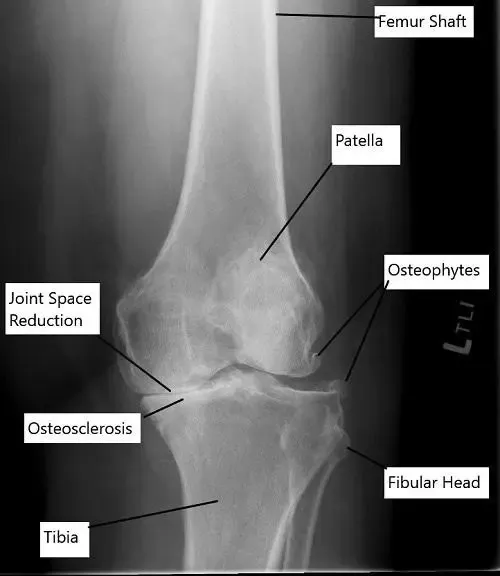
X-ray showing osteoarthritis of the knee.
When to consider viscosupplementation
Viscosupplementation is usually considered after simpler measures have fallen short. Non-surgical care includes rest, activity changes, physical therapy, weight management, braces, anti-inflammatory medicines, and cortisone injections.
It is a good fit for people who are not ready for surgery, or who want to put it off, and whose arthritis is not yet advanced. It is worth seeing a specialist when knee pain limits daily activities, keeps returning, or does not improve with basic care.
Viscosupplementation vs cortisone injections
Both are injections, but they do different jobs. A cortisone injection reduces inflammation in the joint, which eases arthritis pain for a while, but once the steroid wears off the inflammation and pain tend to come back.
Viscosupplementation instead improves the lubrication of the joint by topping up its hyaluronic acid. For the right patient, this can give longer-lasting relief than a steroid shot, and it is of most benefit in the earlier stages of arthritis before the cartilage is fully worn.
The viscosupplementation procedure
The injection is done as an outpatient procedure in the office. The skin over the knee is cleaned, and the hyaluronic acid gel is injected straight into the joint through a thin needle.
Some people feel mild discomfort during the injection, but it is generally well tolerated and takes only a few minutes.
Recovery and what to expect
Most people go back to normal activities the same day, but it is best to avoid strenuous exercise for a few days. Relief comes at different speeds: some people feel better right away, while others need several weeks to notice a change.
Your doctor may also give you knee-strengthening exercises to support the recovery.
Risks and side effects
The risks are low. The most common is temporary soreness, swelling, or warmth at the injection site. Rarely, someone has an allergic reaction to the hyaluronic acid.
The main limitation is that it may not help much once arthritis is advanced and the cartilage is badly worn.
How long relief lasts
Many people get longer-lasting relief than they would from a steroid injection. The treatment works best when the arthritis is not too far along. People with severe cartilage loss may notice less benefit and may need other treatments, including surgery.
Protecting your knee long-term
You can support the result and slow flare-ups with a few habits: stay active with low-impact exercise like walking, cycling, or swimming, keep to a healthy weight to take pressure off the joint, wear supportive shoes, and avoid high-impact strain.
A balanced diet with enough calcium, vitamin D, and protein, plus good hydration, supports the bone and joint fluid too.
When to see a doctor
See a specialist if knee pain limits your daily activities, keeps coming back, or does not improve with rest, ice, and over-the-counter pain relievers.
Seek emergency care if you develop sudden severe swelling, a fever along with knee pain, an inability to move the knee, or a knee that becomes very red and warm after an injection.
Insurance & Cost
Knee Viscosupplementation at Complete Orthopedics is covered by Medicare and most major insurance carriers (Aetna, Anthem BCBS, Cigna, Empire BCBS, UnitedHealthcare), as well as most workers’ compensation and no-fault insurance plans. Your out-of-pocket cost depends on your specific plan, deductible, and the medical necessity criteria that apply to your case.
Call our billing team at (631) 981-2663 before scheduling to verify your coverage and discuss expected out-of-pocket costs. For the full list of carriers we accept and patient billing protections, see our Insurance Information page.
Do you have more questions?
Can viscosupplementation be used to treat knee pain caused by conditions other than osteoarthritis?
Viscosupplementation is primarily indicated for knee osteoarthritis, but it may also be considered as a treatment option for other conditions that cause knee pain, such as rheumatoid arthritis or traumatic injury.
How does the cost of viscosupplementation compare to other treatments for knee osteoarthritis?
The cost of viscosupplementation varies depending on factors such as the type of hyaluronic acid used, the number of injections required, and your insurance coverage.
Can viscosupplementation be used as a preventive measure for knee osteoarthritis?
While viscosupplementation is primarily used to treat existing knee osteoarthritis, some research suggests that it may have a role in preventing further cartilage damage and delaying the progression of osteoarthritis.
Are there any alternative treatments to viscosupplementation for knee osteoarthritis?
Yes, alternative treatments for knee osteoarthritis include oral medications, physical therapy, corticosteroid injections, platelet-rich plasma (PRP) therapy, and surgical interventions such as knee replacement. Your orthopedic surgeon can help determine the most appropriate treatment approach based on your individual needs and preferences.
What is the rooster comb shot?
A rooster comb shot is another name for viscosupplementation as hyaluronic acid is found in high concentration in the comb of the rooster and is traditionally related to it.
What are the side effects of Synvisc?
Side effects of Synvisc include pain, swelling, allergic reaction with the injection. If the injection is wrongly put into the soft tissue rather than the joint, then it may cause localized swelling and worsening of the pain.
Is hyaluronic acid a steroid?
Hyaluronic acid injections are not steroid injections. Though they have anti-inflammatory characteristics like steroids, they usually do not have the detrimental side effects of steroids.
Who is a good candidate for viscosupplementation injection?
Patients who are allergic or unwilling to get cortisone injections or who are no longer relieved with cortisone injections and have pain due to arthritis are good candidates for viscosupplement injections. Patients with early arthritis are also good candidates for viscosupplementation.
Can viscosupplementation be alternative for people looking to avoid surgery?
Patients who are trying to avoid surgeries due to various reasons can try viscosupplementation to improve their symptoms and avoid or delay the surgery. If these patients are in an advanced disease stage, then these injections may not be helpful.
What are the experiences of stem cell or PRP injections for joint regeneration?
PRP injection is more commonly used nowadays clinically and have shown promising results lasting a 3-6 months. If the patient is unwilling to take cortisone injection or is allergic to cortisone/viscosupplementation, they can have PRP injections for pain relief.
Can a cortisone shot help a torn meniscus?
A cortisone shot in a scenario of torn meniscus can help decrease pain and swelling. It though will not cause healing of the meniscus.
The content on this page has been authored, edited, or approved by the doctors below, and was last reviewed for accuracy on July 2, 2026.