

This is a hip replacement that combines two modern features: the anterior approach (reaching the hip from the front, which spares muscles and speeds recovery) and robotic assistance, using a system called MAKO.
The key idea is precision. Before surgery, a detailed scan of your hip is used to build a 3D model and a surgical plan made specifically for your anatomy.
During the operation, a robotic arm guides the surgeon to place the new hip parts exactly where the plan calls for. One important point: the robot doesn’t perform the surgery, your surgeon does, staying in full control the whole time and using the robot as a highly percise guide.
Getting the parts placed accurately helps the new hip feel natural, last longer, and avoid problems like dislocation or uneven leg length.
This page explains the condition it treats, how the robotic surgery works, and what to expect.
What condition does this treat:
This treats hip pain and stiffness caused by a damaged hip joint, most often from arthritis. Several things can lead to it:
- Osteoarthritis. This is due to common wear-and-tear breakdown of the joint’s smooth cartilage, and the most common reason for hip replacement.
- Post-traumatic arthritis. This is arthritis that develops after an previous injury or fracture.
- Inflammatory arthritis. This is caused by conditions where the body’s own immune system damages the joint.
- Hip dysplasia. This is a hip that didn’t form as we would normally expect. These are usual related to genetics and childhood factors, that result in an abnormal hip.
When the cushioning in the joint wears down, the bones rub and the hip becomes painful and stiff, making everyday movement hard.
When should you consider surgery:
As with any hip replacement, surgery comes after non-surgical treatments have been tried for several months, and haven’t given enough relief. This includes medication, physical therapy, activity modification, weight reduction, assistive devices, and injections.
If your hip pain persists despite non-operative treatment, and getting in the way of daily life, a hip replacement may help. The robotic, front-approach version is one way to do that replacement.
Whether it’s the right fit for you depends on your anatomy and your surgeon’s assessment.
What happens during surgery:
The process actually starts a few weeks before surgery. You get a detailed scan (CT scan) of your hip. That scan is turned into a 3D model of your exact anatomy, and the surgeon uses it to build a personalized plan for where each hip replacement part should go.
On the day of surgery, the surgeon reaches the hip from the front, gently separating the muscles instead of cutting through them. Then, using the robotic arm as a guide, we:
- Remove only the worn, arthritic bone. The robotic system helps avoid taking out more healthy bone than needed.
- Place a metal cup into the socket, lined with a smooth plastic insert that lets the joint glide.
- Fit a stem into the top of the thigh bone and attach a new ball on top.
- Check that everything moves smoothly and sits correctly, measure the limb parameters, then close up the incision.
Throughout, the robotic arm gives the surgeon real-time guidance to match the pre-made plan with the real time positioning. However, the surgeon makes every decision and can adjust the plan during surgery as needed. The robot never acts on its own.
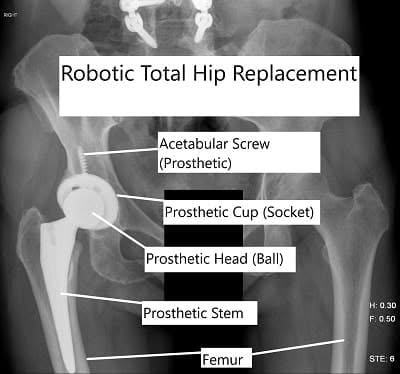
X-ray showing robotic total hip replacement
What does recovery look like:
Because this uses the front (anterior) approach, recovery tends to be quicker than with older techniques that cut through more muscle. Many people can put weight on the leg early with fewer of the strict “hip precautions” that other approaches require.
Recovery focuses on physical therapy to rebuild strength and movement. Most patients work their way back to the activities they enjoy. The precise placement the robot helps with can support a smoother recovery and a hip that feels more natural. Your exact timeline depends on your health and activity level, and your surgeon will give you a plan.
Generally, you are up and walking the same day of surgery, and might be able to go home the same day of surgery. At 6 weeks most patients are walking relatively pain free. They have graduated from canes or walkers. Most are driving and back at work.
By 3 months most patients have returned to their usual activities. However it may take a full year to fully recover after surgery.
What are the major risks and complications:
Even with robotic assistance, this is still major surgery and carries the same general risks as any hip replacement. Your surgeon will go over these with you. They include:
- Blood clots in the leg, which can be dangerous if one travels to the lungs. We give you medicaiton to prevent this.
- Infection at the wound or deeper around the implant. If you have a deep infection, it may warrant another operation.
- Dislocation, where the new ball slips out of the socket. Usually this required putting the hip back in place under sedation.
- A bone fracture around the implant. Usually this required additional surgery
- Nerve or blood vessel injury near the surgical area. This typically resolves over time.
- Uneven leg length is possible, but rare with the use of robotics.
- Ongoing pain is rare but possible
The goal of the robotic, patient-specific planning is to lower the chances of some of these by placing the components more precisely. This particularly effects the risk of dislocation, uneven leg length, and patient satisfaction (early on).
What if you don’t have surgery:
Surgery isn’t required, and many people manage hip arthritis for a long time with medication, physical therapy, and injections. Those are reasonable first steps. But arthritis doesn’t heal on its own. It is a slow, progressive, chronic condition.
The joint generally keeps wearing down, so for many people the pain and stiffness slowly worsen and everyday activities get harder over time. Non-surgical care can ease symptoms but doesn’t repair the underlying damage.
It’s also worth remembering that the robotic anterior technique is just one way to do a hip replacement. If you do decide on surgery, your surgeon can talk you through whether this approach is the best fit. When and how to proceed is a decision to make together based on your symptoms and how much your hip is affecting your life.
Benefits of anterior robotic surgery:
Compared to traditional surgical techniques, Anterior Hip replacement assisted work MAKO System offers several benefits:
- Precise alignment and placement of the implant components based on patient-specific anatomy.
- Removal of only diseased bone and preservation of bone stock.
- Reduced blood loss during the surgery.
- Duplication of the biomechanics of the hip joint leading to the feeling of a natural hip.
- Decreased rate of complications such as hip dislocation or leg length discrepancy.
- Better patient pain and function scores in the early periods after surgery
- Better component placement, particularly in cases of trauma, previous hardware, deformity, and hip dysplasia
Do you have more questions?
How does the recovery time for MakoPlasty compare to other minimally invasive hip replacement techniques?
Recovery time for MakoPlasty is often shorter compared to traditional hip replacement surgeries due to its minimally invasive nature and precision.
Are there any specific age limitations for patients undergoing MakoPlasty Anterior Hip Replacement?
Age alone isn’t a determining factor. The candidacy depends more on overall health and bone quality.
Can MakoPlasty technology be used to correct leg length inequality after hip replacement surgery?
Yes, MakoPlasty can address leg length discrepancies by precisely adjusting implant placement during surgery.
Are there any specific exercises or rehabilitation protocols recommended after MakoPlasty surgery?
Yes, rehabilitation typically involves physical therapy exercises to improve strength, flexibility, and mobility, tailored to each patient’s needs.
How long does the MakoPlasty procedure typically take from start to finish?
The duration varies but generally takes around 1-2 hours, depending on factors such as patient anatomy and complexity of the case.
What factors determine whether a patient is a good candidate for MakoPlasty versus traditional hip replacement?
Factors include age, bone quality, overall health, and surgeon preference. MakoPlasty is particularly beneficial for patients with complex anatomies or those seeking a more precise outcome.
Are there any dietary restrictions or nutritional recommendations before and after MakoPlasty surgery?
Generally, no specific dietary restrictions are necessary, but maintaining a balanced diet rich in nutrients can aid in recovery.
Can MakoPlasty Anterior Hip Replacement be performed on patients with a history of prior hip surgeries?
Yes, MakoPlasty can be performed on patients with a history of prior hip surgeries, although individual circumstances may vary.
How does the cost of MakoPlasty surgery compare to traditional hip replacement methods?
The cost may vary depending on factors such as hospital fees, surgeon fees, and insurance coverage. Have a look at our insurance page for more specific information.
What is the long-term success rate of MakoPlasty Anterior Hip Replacement compared to traditional methods?
Long-term success rates are generally favorable for MakoPlasty, with many patients experiencing improved function and pain relief. In the long term, they are similar to conventional hip replacement surgery
Can MakoPlasty technology be used for other types of joint replacement surgeries besides the hip?
Yes, MakoPlasty technology is also used for knee replacement surgeries, providing similar benefits of precision and minimal invasiveness.
What are the potential risks associated with anesthesia during MakoPlasty surgery?
Anesthesia risks are similar to those of any surgical procedure and may include reactions to medications, respiratory issues, or complications related to pre-existing medical conditions. However, these risks are typically low and managed by experienced anesthesia providers.
How soon after MakoPlasty surgery can patients return to driving and other daily activities?
Patients typically resume driving and light daily activities within a 3-6 weeks to a month after surgery, depending on individual recovery progress and clearance from their surgeon.
Are there any restrictions on bending, twisting, or lifting heavy objects after MakoPlasty surgery?
Initially, patients are advised to avoid strenuous activities and heavy lifting to allow for proper healing. Specific restrictions may vary depending on individual circumstances and surgeon recommendations. In the long run, these restrictions are usually not relevant.
Can MakoPlasty surgery be performed on both hips simultaneously?
While it is possible to perform bilateral MakoPlasty surgeries, this approach may increase the complexity of recovery and rehabilitation and is typically reserved for select cases.
What measures are taken to ensure proper alignment and stability of the hip joint during MakoPlasty surgery?
The robotic arm system used in MakoPlasty provides real-time feedback to the surgeon, enabling precise adjustments to optimize implant placement and joint alignment.
Is there a risk of infection or implant-related complications after MakoPlasty surgery?
While all surgeries carry some risk of infection or implant-related issues, MakoPlasty’s minimally invasive approach and sterile techniques help minimize these risks.
The content on this page has been authored, edited, or approved by the doctors below, and was last reviewed for accuracy on June 8, 2026.