

Hip resurfacing is a type of hip replacement, but a more bone-sparing one. In a standard hip replacement, the surgeon removes the worn ball at the top of your thigh bone and replaces it with a metal ball on a stem.
In hip resurfacing, the ball isn’t removed. Instead it’s trimmed and capped with a smooth metal cover, like putting a crown on a tooth. The worn socket is replaced the same way it would be in a regular hip replacement.
Because it keeps more of your natural bone, resurfacing can be a good option for certain younger, active patients who may need another surgery down the road. But it isn’t right for everyone, and most people with hip arthritis still do better with a standard hip replacement.
This page explains who’s a good candidate, what the surgery involves, and the trade-offs.
What condition is being treated by a hip resurfacing or replacement:
Like a standard hip replacement, resurfacing treats hip arthritis. Your hip is a ball-and-socket joint, and both surfaces are normally coated with smooth cartilage that lets the joint glide.
In arthritis, that cartilage (and the bone underneath) slowly wears away, so the joint gets painful and stiff and makes everyday movement hard. Resurfacing is one way to fix that worn-out joint.
When should you consider surgery:
As with any hip arthritis surgery, a operation is only considered after non-surgical treatments have been tried. This inlcuded several months of pain medicine, physical therapy, injections, activity modification, weight reduction, and assistive devices. If 3-6 months has passed , and the pain is severe enough to warrant a major operation, then surgery should be considered.
But resurfacing has an extra layer of consideration. Not everyone who needs a hip replacement is a good candidate for a resurfracing. It tends to be a better fit for:
- Younger, active patients (usually under 60). Keeping more natural bone helps if they ever need a second surgery later, and the design holds up well for demanding, active lifestyles.
- People with strong, healthy bone, since the natural neck of the thigh bone has to support the metal cap. Weak bone will lead to collapse and fractures.
- People with a misshapen upper thigh bone that can make a standard implant tricky to apply.
It’s generally not a good fit for patients with weaker or thinner bone (such as postmenopausal women or those with bone-thinning conditions), patients with a misshapen socket, patients with noticeably uneven leg lengths, or patients with kidney disease (explained in the risks below). Your surgeon will help you figure out which type of surgery suits your situation.
What happens during surgery:
For hip resurfacing you’ll either be fully asleep under general anesthesia or numbed from the waist down while staying awake but sedated. The surgeon makes a cut, and moves the tissues aside to reach the joint. The hip is exposed. Then we:
- Reshape the worn ball at the top of your thigh bone and cap it with a smooth metal cover, rather than removing it entirely.
- Prepare the socket by gently smoothing away the damaged cartilage and bone.
- Fit a metal cup into the socket. This is either press-fit snugly or held with bone cement.
- Place the new ball-and-socket together, check that everything moves smoothly and stays in place. We then close the incision in layers.
Then rehab begins. One thing worth knowing: modern hip resurfacing uses a metal cap moving against a metal socket (a “metal-on-metal” design). Older versions that paired metal with plastic wore out too fast and are no longer used.
To get an idea what a total hip replacement surgery looks like, have a look at our total hip replacement page. Below are X-Ray representations of both surgeries.
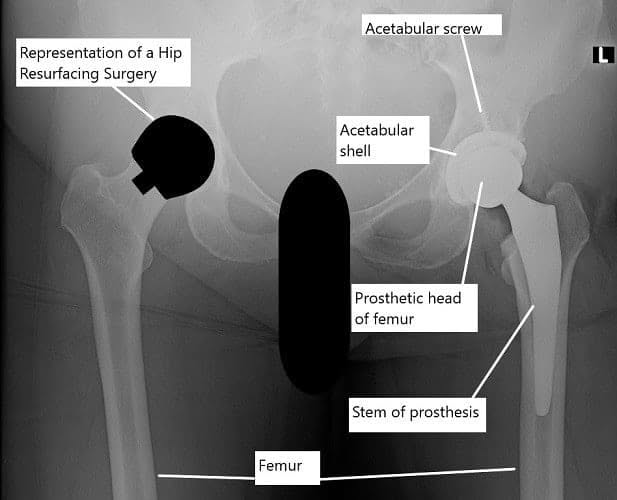
X-ray showing a total hip replacement on the left hip and an illustration of hip resurfacing on the right hip
What does recovery look like:
Recovery is broadly similar to a standard hip replacement. Physical therapy to rebuild strength and movement, with your surgeon guiding how soon you can put weight on the leg. Resurfacing has a couple of recovery advantages worth noting.
The new ball is closer to the size of your natural one, the joint is generally more stable and less likely to slip out of place, and there’s a lower chance of ending up with uneven leg lengths afterward.
Your exact timeline depends on your health and activity level, so your surgeon will tailor a plan for you. Most patients start walking the first day after surgery. Most pain is resolved by 6 weeks after surgery, and many patients are walking without canes / walkers.
Most patients are back and work and start driving again at this stage. By 3 months most patients are back at their baseline activates. However, it may take 1 year to fully recover.
What are the major risks and complications:
Resurfacing shares the general risks of any hip surgery (such as infection, fractures, dislocations, and blood clots), but it also has a few risks that are specific to this procedure:
- A break in the neck of the thigh bone shortly after surgery. Because the natural neck is kept and now carries the load of your body, it can break. If this happens, the resurfacing may have to be converted to a standard hip replacement.
- Metal particles in the blood. The metal-on-metal design releases tiny amounts of metal ions (cobalt and chromium) into the bloodstream. No clear harm has been proven, but the long-term effects aren’t fully known. These particles build up more in people with kidney disease, since the body can’t clear them as well. This is why we avoid resurfacing in patients with underlying kidney problems.
- A metal allergy in some patients, which can cause irritation around the implant and lead to loosening.
- Extra bone forming in the surrounding muscle This procedure can require more tissue handling, which raises that chance of calcification of muscles/tendons/soft tissues.
- Uneven leg length not being corrected. If your legs were already uneven before surgery because of arthritis, resurfacing may not fix that difference.
It is also worth noting that hip resurfacing is not as commonly done as hip replacement surgery. Thus, we do not have as robust data on issues like longevity of the implants, real complications rates, long term complications specific to resurfacing, and patient specific risk factors.
What if you don’t have surgery:
You don’t have to have surgery right away. Many people manage hip arthritis for a long time with medication, physical therapy, and injections. These are reasonable first steps. But arthritis doesn’t improve with time.
It is a slow, chronic, progressive process. The joint tends to keep wearing down. So, for many people the pain / stiffness slowly get worse and daily activities become harder.
There’s also a second decision hiding inside this one: even if you do choose surgery, you may not be a candidate for resurfacing. Specifically, in which case a standard hip replacement would likely be the better route.
Which path makes sense waiting, resurfacing, or a standard replacement, is a conversation to have with an orthopedic joint replacement surgeon based on your age, activity level, bone health, and how much your hip is affecting your life.
Do you have more questions?
Are there any specific lifestyle modifications or restrictions that patients should follow after undergoing hip resurfacing surgery, and for how long should these precautions be maintained?
Patients may need to follow certain lifestyle modifications or restrictions after hip resurfacing surgery to promote proper healing and prevent complications. These may include avoiding high-impact activities, maintaining a healthy weight, and adhering to postoperative rehabilitation guidelines. These precautions may need to be followed for several weeks to months, depending on individual recovery progress.
What are the key differences in postoperative pain management between hip resurfacing surgery and total hip replacement, and how does this impact the patient’s recovery experience?
Postoperative pain management strategies may differ between hip resurfacing surgery and total hip replacement, depending on factors such as surgical technique and patient preferences. Understanding these differences can help patients prepare for their recovery experience and manage pain effectively during the healing process.
What are the potential signs of complications or implant failure that patients should watch out for after undergoing hip resurfacing surgery, and when should they seek medical attention?
Patients should be aware of potential signs of complications or implant failure after hip resurfacing surgery, such as persistent pain, swelling, instability, or limited range of motion in the hip joint. It’s important to seek medical attention promptly if any concerning symptoms arise to ensure timely evaluation and appropriate management.
How does the cost of hip resurfacing surgery compare to total hip replacement, and are there any factors that may influence the overall cost, such as insurance coverage or hospital fees?
The cost of hip resurfacing surgery may vary depending on factors such as geographic location, surgeon experience, hospital fees, and insurance coverage. Have a look at our insurance page to get an idea of costs.
What are the potential benefits of undergoing hip resurfacing surgery in terms of preserving bone stock and facilitating future revision surgeries, particularly for younger patients?
Hip resurfacing surgery offers potential benefits in terms of preserving bone stock and facilitating future revision surgeries, which may be particularly advantageous for younger patients who are more likely to require additional procedures over their lifetime. Understanding these benefits can help patients make informed decisions about their treatment options.
How does hip resurfacing surgery impact the range of motion and stability of the hip joint compared to total hip replacement, and what implications does this have for patients’ functional abilities and activities of daily living?
There is a theoretical slightl advantage in terms of range of motion and activity in hip resurfacing, but both are similar long term. This is worth discussing with your surgeon. Patients may need to adjust their expectations and lifestyle based on these differences to optimize their recovery and overall outcomes.
Are there any specific dietary recommendations or nutritional considerations that patients should follow before and after undergoing hip resurfacing surgery to support optimal healing and recovery?
Nutrition plays a critical role in supporting optimal healing and recovery after hip resurfacing surgery. Patients may benefit from following a balanced diet rich in protein, vitamins, and minerals to promote tissue repair, immune function, and overall health.
How does the risk of implant wear and failure differ between hip resurfacing surgery and total hip replacement, and what factors contribute to the long-term durability of each type of implant?
Hip resurfacing is predominantly done in younger patients, and we anticipate it to require a revision in many cases. Most resurfacing patients fail by the neck of the femur collapsing or fracturing. We do not have robust data hip resurfacing, but standard hip replacements will last over 25 years.
How does the skill and experience of the surgeon performing hip resurfacing surgery impact patient outcomes and the risk of complications, and what criteria should patients consider when selecting a surgeon for the procedure?
The skill and experience of the surgeon performing hip resurfacing surgery can significantly influence patient outcomes and the risk of complications. Patients should carefully evaluate a surgeon’s expertise, training, and surgical volume when selecting a provider for the procedure to ensure optimal results and minimize the risk of adverse events.
What are the potential implications of hip resurfacing surgery for patients’ participation in high-impact activities, sports, or strenuous physical occupations, and how should patients approach returning to these activities postoperatively?
Patients considering hip resurfacing surgery should be aware of the potential implications for their participation in high-impact activities, sports, or strenuous physical occupations. While hip resurfacing may offer certain advantages for younger, more active patients, it’s essential to discuss realistic expectations and activity modifications with a healthcare provider to minimize the risk of implant wear, dislocation, or other complications during recovery and beyond.
What ongoing monitoring or follow-up care is typically recommended for patients after undergoing hip resurfacing surgery?
Ongoing monitoring and follow-up care are essential components of postoperative management for patients who have undergone hip resurfacing surgery. Regular appointments with a healthcare provider allow for the assessment of implant function, detection of potential complications, and implementation of preventive measures to optimize long-term success and durability. Patients should adhere to recommended follow-up schedules and communicate any concerns or changes in symptoms to their healthcare team promptly.
The content on this page has been authored, edited, or approved by the doctors below, and was last reviewed for accuracy on June 8, 2026.