

If you have a herniated or bulging disc in your lower back, it can press on nearby nerves and cause pain, numbness, tingling, or weakness that travels down the leg, often called sciatica. When other treatments such as rest, physical therapy, or medications do not provide enough relief, surgery may be recommended.
Two common surgical options are open discectomy and microdiscectomy. Both procedures are designed to remove the part of the damaged disc that is putting pressure on the nerve, helping to reduce pain and improve movement. Although they have the same goal, the procedures are performed in different ways and may vary in incision size, recovery time, and potential risks.
At Complete Orthopedics, our experienced surgeons provide comprehensive evaluation and advanced treatment options for complex cervical spine conditions.
This page explains when open vs microdiscectomy may be recommended, how the procedure works, and what patients can expect throughout treatment and recovery.
What it is
Lumbar disc herniation is a common cause of sciatica, with a high prevalence in adults between 30 and 50 years old. The condition is particularly common in individuals who engage in activities that strain the lower back, such as heavy lifting or prolonged sitting. Approximately 10-15% of people with lumbar disc herniation will require surgery, with microdiscectomy and open discectomy being the two most common surgical interventions.
Why it Happens
A herniated disc occurs when the soft, inner portion (nucleus pulposus) of an intervertebral disc pushes through a tear in the tough outer layer (annulus fibrosus). This herniation can compress spinal nerves, leading to symptoms like radiating leg pain (sciatica), numbness, tingling, or weakness in the lower extremities. Over time, the spine undergoes degenerative changes, which can contribute to disc bulging and nerve compression. Repetitive stress, trauma, or poor posture can also contribute to the development of disc herniation.
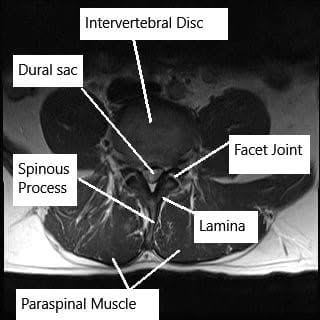
How the Body Part Normally Works
The lumbar spine consists of five vertebrae (L1-L5) separated by intervertebral discs. These discs act as shock absorbers and allow for flexibility and movement of the spine. The spinal cord runs through the spinal canal, and nerves branch out through openings between the vertebrae. These spinal nerves control the sensation and movement of the lower body, including the legs, feet, and pelvic organs. When a disc herniates, it can compress these nerves, leading to symptoms such as pain, numbness, and weakness.
Clinical Presentation
- Radicular Pain (Sciatica): Pain that radiates from the lower back down the buttocks and into the legs.
- Numbness or Tingling: Sensation of “pins and needles” in the legs or feet.
- Weakness: Difficulty lifting the legs or feet, or feeling of instability.
- Back Pain: Localized pain in the lower back, often worsened by activity or movement.
- Loss of Reflexes: Reduced reflexes in the legs due to nerve compression.
Imaging Needed
- Physical Examination: To evaluate reflexes, strength, and areas of pain or numbness.
- MRI (Magnetic Resonance Imaging): The most effective tool for visualizing herniated discs and nerve compression.
- CT Scan: Provides a more detailed image of the bones and joints.
- X-rays: To rule out other causes of back pain such as fractures.
- Electromyography (EMG): To assess nerve function and confirm compression.
Other Problems That Can Feel Similar
Conditions that may mimic the symptoms of lumbar disc herniation include:
- Spinal Stenosis: Narrowing of the spinal canal, often leading to similar symptoms of leg pain and numbness.
- Piriformis Syndrome: Compression of the sciatic nerve by the piriformis muscle in the buttocks.
- Sacroiliac Joint Dysfunction: Pain in the lower back and buttocks that may radiate to the legs.
- Facet Joint Syndrome: Degeneration of the facet joints, causing pain similar to sciatica.
Treatment Options
Non-Surgical Care
- Physical Therapy: Strengthening the back and abdominal muscles to reduce pressure on the spine.
- Medications: NSAIDs or corticosteroids for pain and inflammation relief.
- Epidural Steroid Injections: To reduce inflammation around the nerve roots.
- Nerve Blocks: To target and alleviate pain in specific areas.
Surgical Procedures
Open Discectomy (OD)
- Procedure: Involves a midline skin incision, retraction of paravertebral tissues, partial laminectomy, and removal of the ligamentum flavum to expose the spinal cord and nerve roots. The disc material is then removed, and the posterior longitudinal ligament is opened.
- Duration: Significantly shorter operation time (37.82±7.15 minutes).
Microdiscectomy (MD)
- Procedure: Utilizes a microscope for better visualization, with minimal laminectomy and removal of the ligamentum flavum. The nerve root is retracted medially, and the disc contents are removed.
- Duration: Longer operation time (49.07±6.88 minutes).
What to Expect After Treatment
- Open Discectomy: Recovery time is generally longer due to the larger incision and more extensive tissue manipulation. Patients may need to stay in the hospital for 1-2 days and can expect a return to normal activities in 4-6 weeks.
- Microdiscectomy: Recovery is faster due to the minimally invasive nature of the procedure. Most patients can return to light activities within 1-2 weeks, with full recovery typically taking 4-6 weeks. Patients can usually go home the same day of the surgery.
Possible Risks or Side Effects
- Open Discectomy:
- Infection: At the surgical site.
- Nerve Injury: Rare, but can occur during the surgery.
- Recurrent Herniation: The disc may herniate again at the same level.
- Dural Tear: Accidental tear of the dura mater, requiring repair.
- Microdiscectomy:
- Infection: Low risk, but possible.
- Nerve Injury: Less common due to better visualization.
- Recurrent Herniation: Can occur, but less likely with a successful procedure.
- Dural Tear: Rare, but may occur during the procedure.
Long-Term Outlook
Both open discectomy and microdiscectomy have high success rates for relieving pain and improving function. Most patients experience significant relief from sciatica and return to normal activities within a few weeks to a few months. However, there is a small risk of recurrent herniation, particularly if proper post-operative care is not followed.
Summary and Takeaway
Both open discectomy and microdiscectomy are highly effective surgeries for treating lumbar radiculopathy caused by herniated discs. Microdiscectomy has become the preferred choice due to its minimally invasive nature, quicker recovery, and fewer complications. The choice between the two procedures depends on the patient’s condition, the surgeon’s experience, and other factors like the extent of the herniation and patient preference.
Do you have more questions?
What are the primary symptoms of LDH?
The primary symptoms include lower back pain, radiating leg pain (sciatica), numbness, tingling, and muscle weakness in the legs.
What is lumbar disc herniation (LDH)?
Lumbar disc herniation occurs when the inner gel-like core of a lumbar disc protrudes through its outer layer, compressing nearby nerves. This leads to symptoms like lower back pain, sciatica, and neurological deficits.
What is microdiscectomy (MD)?
Microdiscectomy is a minimally invasive surgical technique using a microscope to provide a clearer view of the surgical area. It involves smaller incisions and less tissue disruption compared to OD.
What are the advantages of MD over OD?
MD results in less tissue damage, reduced postoperative pain, quicker recovery, and a shorter hospital stay due to its minimally invasive nature.
What are the risks associated with OD?
Risks of OD include dural tears, wound infections, nerve root injuries, and reoperation due to recurrent herniation.
What are the risks associated with MD?
Risks of MD include dural tears, wound infections, nerve root injuries, and slightly higher chances of reoperation due to recurrent herniation compared to OD.
Which surgical method has a higher reoperation rate?
MD has a slightly higher reoperation rate (9.5%) compared to OD (6.9%), though the difference is not statistically significant.
What is the postoperative recovery like for patients undergoing MD?
Patients undergoing MD typically experience less postoperative pain, faster mobilization, and shorter hospital stays due to the minimally invasive nature of the procedure.
Are there any specific conditions where one method is preferred over the other?
MD is often preferred for patients who require a minimally invasive approach due to less tissue disruption, while OD may be preferred for surgeons with more experience in open procedures or in cases where direct visualization is necessary.
What are the common complications of spinal surgeries like OD and MD?
Common complications include dural tears, nerve root injuries, wound infections, and reoperation due to recurrent herniation.
What is the significance of the learning curve in MD?
The learning curve for MD can be longer due to the need for proficiency with microscopic techniques, but experienced surgeons can perform it effectively with excellent outcomes.
How does the size of the incision differ between OD and MD?
OD typically involves a larger incision compared to the smaller, minimally invasive incisions used in MD.
What postoperative care is required for patients undergoing OD or MD?
Postoperative care includes pain management, wound care, antibiotics to prevent infections, and physical therapy to aid in recovery and restore function.
How does the surgical experience of the surgeon affect the outcomes of OD and MD?
Surgical experience is crucial in determining outcomes. Experienced surgeons can achieve excellent results with both OD and MD, minimizing complications and improving recovery times.
What future advancements are expected in the treatment of LDH?
Future advancements may include improved endoscopic techniques, robotic-assisted surgeries, and enhanced imaging technologies to further reduce invasiveness, improve precision, and enhance patient outcomes.
The content on this page has been authored, edited, or approved by the doctors below, and was last reviewed for accuracy on July 24, 2026.