
Extreme Lateral Interbody Fusion (XLIF) is a minimally invasive surgical procedure designed to treat various lumbar spine conditions, including degenerative disc disease, spinal stenosis, spondylolisthesis, and scoliosis. By accessing the spine through the side of the body, XLIF reduces the need for extensive tissue dissection and muscle manipulation, resulting in a faster recovery, less pain, and improved clinical outcomes compared to traditional spine surgery approaches.
How Common It Is and Who Gets It? (Epidemiology)
Lumbar spine conditions that require fusion surgery, such as degenerative disc disease and spondylolisthesis, affect millions of individuals worldwide. XLIF is becoming an increasingly popular treatment option for these conditions due to its minimal invasiveness and faster recovery time. It is typically recommended for patients with conditions affecting the lumbar spine from the L2 to L4 vertebrae, although some cases may require an alternative approach for the L5-S1 segment.
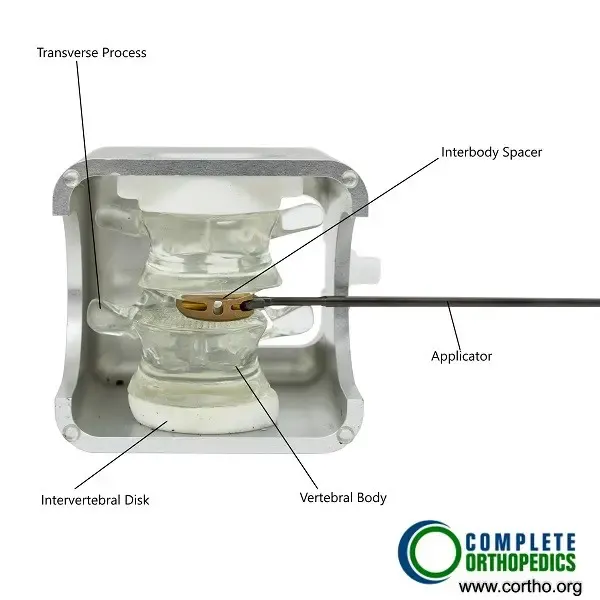
Bone Model showing XLIF.
Why It Happens – Causes (Etiology and Pathophysiology)
Degenerative disc disease (DDD) occurs when the intervertebral discs in the lumbar spine break down over time due to aging, trauma, or overuse. This degeneration causes the discs to lose their flexibility, which can lead to pain, instability, and nerve compression. Other conditions, such as spondylolisthesis (slippage of a vertebra), spinal stenosis (narrowing of the spinal canal), and scoliosis (abnormal curvature of the spine), can also affect the lumbar spine and may require surgical intervention for stabilization.
How the Body Part Normally Works? (Relevant Anatomy)
The lumbar spine consists of five vertebrae (L1-L5) that support the weight of the upper body and allow for flexibility and movement. Between each vertebra is an intervertebral disc that acts as a cushion, absorbing shock and enabling movement. The spinal cord passes through the vertebrae, and spinal nerves branch out to the body. In conditions like DDD or spondylolisthesis, the degeneration of discs or slippage of vertebrae can compress these nerves, leading to pain, weakness, and other neurological symptoms.
What You Might Feel – Symptoms (Clinical Presentation)
Symptoms of lumbar spine conditions include:
- Chronic Low Back Pain: Often worsens with movement or certain activities.
- Radiating Pain: Pain that extends into the hips, legs, or feet (sciatica).
- Numbness and Tingling: In the legs or feet due to nerve compression.
- Muscle Weakness: Especially in the legs or feet.
- Stiffness: Difficulty moving or bending due to pain or instability.
How Doctors Find the Problem? (Diagnosis and Imaging)
Diagnosis is typically made through a combination of:
- Physical Examination: To assess range of motion, pain levels, and neurological function.
- X-rays: To assess the alignment of the spine and identify degeneration or instability.
- MRI or CT Scans: To evaluate the soft tissues, discs, and nerves for compression or degeneration.
- Electromyography (EMG): To assess nerve function and detect any nerve damage.
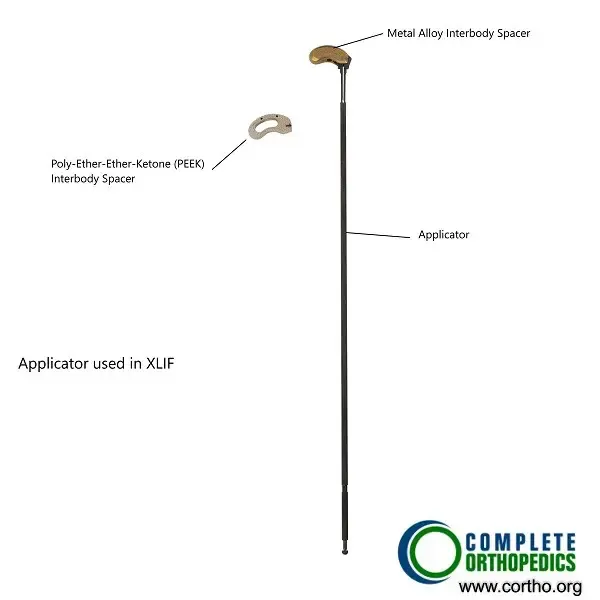
Instruments used in XLIF and Interbody spacer.
Classification
XLIF is suitable for treating conditions such as:
- Degenerative Disc Disease: Causing chronic low back pain and reduced mobility.
- Spinal Stenosis: Narrowing of the spinal canal leading to nerve compression.
- Spondylolisthesis: Vertebral slippage requiring stabilization.
- Scoliosis: Spinal curvature affecting functional ability.
Other Problems That Can Feel Similar (Differential Diagnosis)
Conditions that may mimic lumbar spine issues include:
- Facet Joint Osteoarthritis: Degeneration of the small joints in the back of the spine.
- Herniated Disc: A disc that bulges out of place and presses on a nerve.
- Muscle Strain: Overuse or injury of the muscles in the lower back.
- Piriformis Syndrome: Compression of the sciatic nerve by the piriformis muscle.
Treatment Options
- Non-Surgical Care: Physical therapy, medications (NSAIDs, muscle relaxants), and steroid injections.
- Surgical Care: XLIF for conditions such as severe disc degeneration, spondylolisthesis, or scoliosis.
- Postoperative Care: Includes pain management, physical therapy, and regular follow-up visits to monitor recovery.
Recovery and What to Expect After Treatment
- Hospital Stay: Most patients can go home the same day or after a short stay.
- Pain Management: Postoperative pain is generally less than traditional surgery and is managed with medications.
- Physical Therapy: Essential for restoring movement, strength, and flexibility in the neck and back muscles.
- Activity Restrictions: Avoid heavy lifting, bending, or twisting during the initial stages of recovery. Follow-up visits with the surgeon are necessary to monitor progress.
Possible Risks or Side Effects (Complications)
Like any surgical procedure, XLIF carries some risks, including:
- Nerve Injury: Due to proximity to major nerves during the lateral approach.
- Infection: Risk of infection at the surgical site, although relatively rare.
- Hardware Failure: In rare cases, the cage, screws, or rods may fail and require revision surgery.
- Persistent Pain: Some patients may continue to experience pain despite surgery.
Long-Term Outlook (Prognosis)
XLIF has been shown to provide long-term relief for most patients, with improved pain relief and restored spinal function. The procedure helps to maintain spinal motion, reducing the risk of adjacent segment degeneration compared to spinal fusion. Long-term outcomes are generally favorable, and patients typically experience a good quality of life post-surgery.
Out-of-Pocket Cost
Medicare
CPT Code 22558 – Extreme Lateral Interbody Fusion (XLIF): $368.50
Under Medicare, 80% of the approved amount for this procedure is covered once the annual deductible has been met. The remaining 20% is typically the patient’s responsibility. Supplemental insurance plans—such as Medigap, AARP, or Blue Cross Blue Shield—generally cover this 20%, leaving most patients with little to no out-of-pocket expenses for Medicare-approved XLIF surgeries. These supplemental plans work directly with Medicare to provide comprehensive coverage for advanced spinal fusion procedures.
If you have secondary insurance—such as Employer-Based coverage, TRICARE, or Veterans Health Administration (VHA)—it acts as a secondary payer once Medicare has processed the claim. After your deductible is satisfied, the secondary plan may cover any remaining balance, including coinsurance or small residual charges. Secondary plans typically have a modest deductible, ranging from $100 to $300, depending on the policy and network status.
Workers’ Compensation
If your spine condition requiring XLIF surgery is work-related, Workers’ Compensation will fully cover all medical and surgical costs, including the procedure, hospitalization, and rehabilitation. You will have no out-of-pocket expenses under an accepted Workers’ Compensation claim.
No-Fault Insurance
If your spine condition requiring XLIF surgery resulted from a motor vehicle accident, No-Fault Insurance will pay for all related surgical and hospital expenses. The only potential out-of-pocket cost may be a small deductible, depending on the terms of your policy.
Example
David, a 64-year-old patient with severe lumbar instability, underwent extreme lateral interbody fusion (CPT 22558) to relieve his pain and restore spinal stability. His estimated Medicare out-of-pocket cost was $368.50. Since he had supplemental insurance through Blue Cross Blue Shield, the 20% that Medicare did not cover was fully paid, leaving him with no out-of-pocket expenses for the surgery.
Frequently Asked Questions (FAQ)
Q. How does XLIF compare to traditional fusion surgeries?
A. XLIF offers several advantages over traditional fusion surgeries, including a minimally invasive lateral approach that reduces muscle damage, faster recovery times, and the ability to maintain spinal motion at the treated segment.
Q. What should I expect in terms of recovery time?
A. Most patients experience a quicker recovery with XLIF compared to traditional fusion surgeries. Many patients return to normal activities within 6 to 12 weeks.
Summary and Takeaway
Extreme Lateral Interbody Fusion (XLIF) is a minimally invasive procedure that offers numerous advantages over traditional spine surgery. It is particularly effective for treating conditions such as degenerative disc disease, spondylolisthesis, and spinal stenosis. With its reduced recovery times, preserved spinal motion, and improved patient outcomes, XLIF is a highly effective surgical option for those suffering from lumbar spine conditions.
Clinical Insight & Recent Findings
A recent study evaluated the use of stand-alone extreme lateral interbody fusion (SA-XLIF) for treating radicular symptoms in patients with degenerative lumbar scoliosis and spondylolisthesis.
The study demonstrated that SA-XLIF provided significant symptom relief in 89.5% of patients, with a median surgery time of 106 minutes and minimal blood loss (200 mL). In cases where additional decompression was required, it was successfully performed, yielding high success rates without the need for posterior instrumentation.
Notably, the procedure was well-suited for elderly patients, offering a less invasive approach with faster recovery times and lower complication rates compared to traditional methods. (“Study of SA-XLIF for lumbar degenerative conditions – See PubMed.“)
Who Performs This Treatment? (Specialists and Team Involved)
XLIF is performed by orthopedic spine surgeons with specialized training in minimally invasive spine surgery. The surgical team may also include anesthesiologists, surgical nurses, and rehabilitation specialists who play a role in the patient’s recovery.
When to See a Specialist?
If you are experiencing chronic lower back pain, numbness, tingling, or weakness in your legs, it may be time to consult a spine specialist to determine if XLIF is the right treatment option for your condition.
When to Go to the Emergency Room?
Seek emergency care if you experience sudden severe back pain, difficulty moving your legs, or loss of bladder or bowel control, as these could be signs of a more serious spinal condition requiring immediate attention.
What Recovery Really Looks Like?
While recovery from XLIF is generally quicker than traditional fusion surgeries, patients should follow their surgeon’s recommendations carefully. Physical therapy plays a crucial role in regaining full function, and most patients can return to regular activities in a few months.
What Happens If You Ignore It?
If left untreated, lumbar spine conditions such as degenerative disc disease and spondylolisthesis can lead to worsening pain, nerve damage, and loss of function. Early intervention with XLIF can help prevent these complications and restore spinal health.
How to Prevent It?
Maintaining proper posture, regular exercise to strengthen the core and back muscles, and avoiding heavy lifting can help prevent lumbar spine conditions. Regular check-ups with a spine specialist can also help detect early signs of spinal issues.
Nutrition and Bone or Joint Health
Eating a diet rich in calcium, vitamin D, and other bone-healthy nutrients can help maintain spinal health and prevent conditions that may require surgery. Proper hydration also supports joint health and flexibility.
Activity and Lifestyle Modifications
Post-surgery, patients are advised to avoid high-impact activities and heavy lifting until they are fully recovered. Gentle exercises and physical therapy will help strengthen the muscles surrounding the spine and improve flexibility.
Do you have more questions?
How does XLIF differ from traditional spinal fusion techniques?
XLIF accesses the spine laterally, whereas traditional techniques access it from the back (posterior) or front (anterior). This lateral approach minimizes muscle dissection, resulting in less postoperative pain and faster recovery.
What are the main benefits of XLIF compared to traditional approaches?
XLIF offers minimally invasive access, reduced muscle dissection, shorter hospital stays, and improved outcomes in pain relief and functional recovery.
What preoperative evaluations are necessary before undergoing XLIF?
Comprehensive evaluations including imaging studies like MRI and CT scans are necessary to accurately identify the spinal pathology, aiding in precise surgical planning.
Can XLIF be used to treat all types of spinal disorders, or are there specific conditions it’s most effective for?
XLIF is particularly effective for conditions like degenerative disc disease, spinal stenosis, spondylolisthesis, and scoliosis in the lumbar spine, but it may not be suitable for all spinal disorders.
How is anesthesia administered during XLIF, and why is the patient positioned on their side?
General anesthesia is administered, and the patient is positioned on their side to expose the flank area for the lateral surgical approach.
What are the key steps involved in the XLIF procedure?
The procedure involves making a small incision, navigating through the psoas muscle to reach the targeted intervertebral disc, removing the degenerated disc, inserting an interbody cage filled with bone graft material, and potentially using posterior fixation for spinal stability.
Is XLIF always performed as a standalone procedure, or are there cases where additional fixation is necessary?
While XLIF can provide primary stability with the interbody cage, additional posterior fixation with rods and screws may be used in some cases to enhance spinal stability.
What are the potential risks and complications associated with XLIF surgery?
Risks include nerve injury, infection, hardware failure, and persistent pain.
Are there any specific postoperative care instructions that patients need to follow after XLIF?
Postoperative care includes effective pain management, structured rehabilitation programs, and regular follow-up appointments for monitoring healing and addressing complications.
How long does it typically take to recover from XLIF surgery?
Recovery times vary, but patients often experience quicker recovery and shorter hospital stays compared to traditional spinal fusion surgeries.
Can XLIF be performed on patients who have had previous spine surgeries?
XLIF can be performed on select patients who have had previous spine surgeries, but careful evaluation is necessary to assess suitability.
What are the differences in recovery time between XLIF and traditional spinal fusion techniques?
Recovery from XLIF is typically quicker due to its minimally invasive nature and reduced tissue disruption.
How does XLIF compare in terms of long-term outcomes, such as fusion rates, with traditional approaches?
XLIF has shown comparable or improved long-term outcomes, including fusion rates, compared to traditional approaches in clinical studies.
Are there any limitations or contraindications to undergoing XLIF?
XLIF may not be suitable for all patients, particularly those with certain anatomical limitations or medical conditions.
How soon after surgery can patients expect to experience pain relief?
Many patients report immediate pain relief or significant improvement shortly after XLIF surgery.
What type of rehabilitation program is recommended following XLIF surgery?
Rehabilitation typically includes physical therapy exercises aimed at enhancing strength, flexibility, and spinal stability.
Are there any age restrictions for undergoing XLIF?
There are typically no strict age restrictions, but suitability for surgery is assessed on a case-by-case basis.
What factors determine whether a patient is a suitable candidate for XLIF?
Factors such as the specific spinal pathology, overall health, and anatomical considerations determine suitability for XLIF.
What advancements in surgical technology have improved the XLIF procedure?
Advancements include improved imaging and navigation systems, as well as advancements in biological materials for bone grafting.
How does XLIF compare to other minimally invasive spinal fusion techniques, such as TLIF or DLIF?
XLIF offers unique advantages such as lateral access and reduced muscle dissection compared to other minimally invasive techniques.
What ongoing research is being conducted to further improve XLIF outcomes and expand its indications?
Research focuses on refining surgical techniques, enhancing fusion rates, and expanding the indications for XLIF to include more complex spinal pathologies.