

A partial hip replacement replaces only half of the hip joint. The hip is a ball-and-socket joint, and in this surgery the surgeon replaces just the worn or broken ball at the top of the thigh bone. This leaves the natural socket in place. A total hip replacement, by contrast, replaces both the ball and the socket. These days, partial replacement is done for a fairly small, specific group of people. It’s most often used for older adults who have broken the upper part of the thigh bone and whose socket is still healthy. Because it’s a shorter, less risky operation than a total hip replacement, it can be a safer choice for frail patients. This page explains who it’s for, how it works, and why a total hip replacement is usually preferred for most other people.
What condition does this treat:
This is mainly used for two situations:
- A broken neck portion of the femur bone (the bony «bridge» just below the ball). This bridge also carries the blood supply to the ball. When it breaks, that blood supply can be cut off, and the ball can essentially die from lack of blood. If that happens, and if the socket isn’t arthritic, replacing just the ball portion of the femur makes sense. This is the main reason partial replacement is still done, and it’s considered the standard treatment for this type of fracture in older adults.
- Older patients with limited mobility and other health conditions, for whom a shorter, less stressful operation is safer.
It is generally not recommended for hip arthritis or for active people. If there is significant arthritis on the socket side of the joint, then this procedure is not ideal.
When should you consider surgery:
For the patients with a fracture of the neck portion of the femur, this surgery is done 99.9% of the time. A displaced fracture like this won’t heal on its own and leaves the person unable to walk or bear weight. The more important question is usually which surgery, a partial replacement or a total hip replacement. Partial replacement tends to be chosen when the patient is older, less active, has other health problems that make a longer operation risky. They also need to have a non arthritic healthy socket portion of the hip. A younger or more active person, or someone with an arthritic socket, is usually better served by a total hip replacement.
What happens during surgery:
You’ll be either fully asleep or numbed from the waist down. The surgeon usually reaches the hip from the front or back (and may use robotic or minimally invasive methods). Then they:
- Remove the damaged or broken ball at the top of the thigh bone.
- Leave the socket alone. Unlike a total replacement, the socket isn’t reshaped or replaced.
- Prepare the hollow space inside the thigh bone using shaping tools, paying close attention to the angle.
- Insert a metal stem (held by a snug press-fit or with bone cement) and attach a new ball on top.
- Fit the new ball into your natural socket, check that it’s stable and moves well and that your leg lengths are even, and close up.
Most of these surgeries use a bipolar design, which is a clever «ball-within-a-ball»: a smaller metal ball rotates inside a larger one, with a smooth plastic layer between them. This gives the joint more stability and movement and helps protect your natural socket. (An older unipolar design, which is just a single fixed ball, is rarely used now.) The whole operation typically takes about an hour, and is shorter than a total replacement.
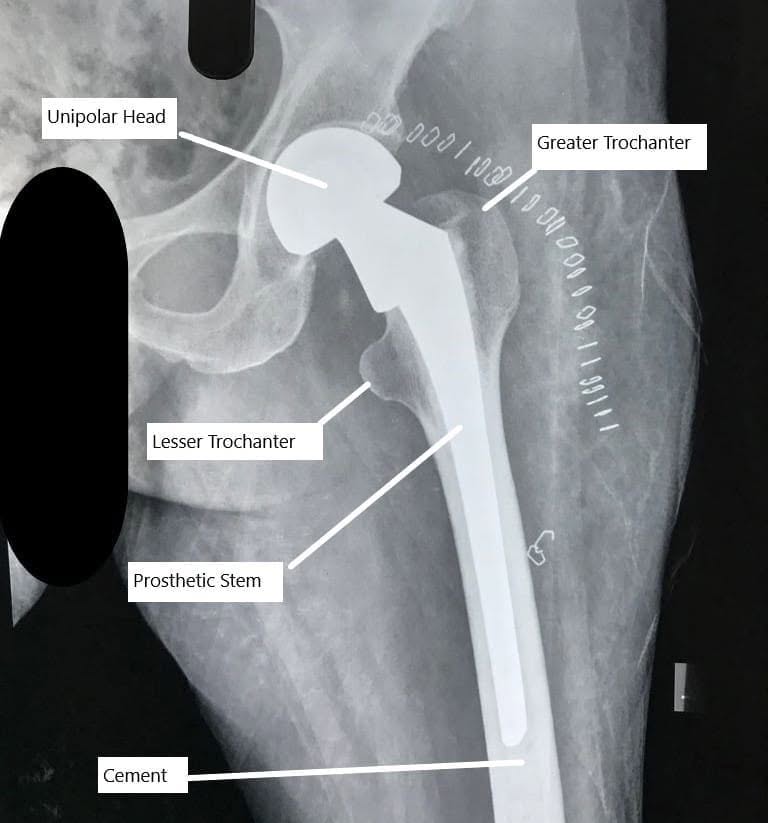
Radiografía de reemplazo unipolar parcial de cadera
What does recovery look like:
Recovery tends to be quicker than a total hip replacement, mostly because the operation itself is shorter and involves less blood loss. However, in the setting of fracture, trauma to the soft tissue may slow progress slightly. Most people are up and walking with support the day after surgery. Because many of these patients are older and less mobile to begin with, the focus is on getting them moving safely as soon as possible. Outside of this, recovery is similar to a total hip replacement.
What are the major risks and complications:
Partial replacement carries the general risks of any hip surgery , such as infection, blood clots, dislocation, and bleeding among them. One risk worth understanding is specific to this procedure over the long term. The artificial ball rubs directly against your natural socket cartilage. This cartilage can slowly wear down, causing increasing pain over time. This is why partial replacement isn’t a good choice for active young patients. The more you move, the faster that wear happens. For the older, less active patients this trade-off is usually acceptable. Your surgeon will go over how the risks apply to your situation.
What if you don’t have surgery:
In the setting of a fracture of the neck portion of the femur, treating this non-operatively is not recommended. A displaced fracture like this generally won’t heal on its own, so the person is left in pain and unable to walk. Staying immobile is especially dangerous for older adults, who can develop serious complications from being unable to move. So while surgery is always a personal decision made with your doctor, surgery is strongly recommended for these fractures. For hip arthritis, the decision is different. Partial replacement isn’t recommended, so the real choice there is between non-surgical care and a total hip replacement. Your surgeon can help you weigh the options based on your specific situation.
Insurance & Cost
We work with Medicare, most commercial insurance carriers (Aetna, Anthem BCBS, Cigna, Empire BCBS, UnitedHealthcare), and most workers’ compensation and no-fault insurance carriers. Coverage for first ray amputation depends on your specific plan and the medical necessity criteria that apply to your case. Call our billing team at (631) 981-2663 before scheduling to verify your coverage and discuss expected out-of-pocket costs.
For the full list of carriers we accept and patient billing protections, see our Insurance Information page.
Para información sobre el procedimiento de reemplazo total de cadera y el coste, por favor haga clic aquí.
¿Tienes más preguntas?
¿Qué tipos de afecciones o lesiones de cadera se tratan habitualmente con la prótesis parcial de cadera?
La prótesis parcial de cadera se utiliza a menudo para tratar afecciones como fracturas de cuello femoral, necrosis avascular de la cabeza femoral y ciertos tipos de artritis de cadera que afectan principalmente a la cabeza femoral.
¿Cuáles son las desventajas de la prótesis parcial de cadera en comparación con la prótesis total?
Las desventajas de la prótesis parcial de cadera pueden incluir un mayor riesgo de necesitar cirugía de revisión en el futuro si la artritis progresa, durabilidad limitada de la prótesis femoral y posibles dificultades para lograr una alineación y estabilidad óptimas.
¿Cuáles son las ventajas de la prótesis parcial de cadera en comparación con la prótesis total?
La prótesis parcial de cadera puede ofrecer ventajas como la preservación del hueso y los tejidos blandos, una recuperación potencialmente más rápida, menor riesgo de luxación y un enfoque quirúrgico más conservador para ciertos pacientes.
¿Cómo determinan los cirujanos si un paciente es candidato para un reemplazo parcial de cadera o para un reemplazo total?
Los cirujanos tienen en cuenta factores como la extensión del daño en la articulación de cadera, la edad del paciente, su nivel de actividad, la calidad ósea y la salud general al determinar el tipo de cirugía de reemplazo de cadera más adecuado.
¿Cuál es la principal diferencia entre un reemplazo parcial de cadera y un reemplazo total de cadera?
El reemplazo parcial de cadera consiste en reemplazar solo la parte dañada de la articulación de la cadera, normalmente la cabeza femoral, mientras se preserva el acetábulo. El reemplazo total de cadera consiste en sustituir tanto la cabeza femoral como el acetábulo por componentes protésicos.
¿En qué difiere el riesgo de complicaciones postoperatorias entre una prótesis parcial de cadera y una prótesis total de cadera?
El reemplazo parcial de cadera puede estar asociado con un menor riesgo de ciertas complicaciones postoperatorias, como luxación y lesiones nerviosas, en comparación con el reemplazo total de cadera, ya que la cirugía implica preservar más la anatomía nativa de la cadera y los tejidos blandos. Sin embargo, el riesgo global de complicaciones depende de varios factores, incluyendo factores específicos del paciente y la técnica quirúrgica.
¿Existen restricciones para conducir o volver al trabajo tras una cirugía de reemplazo parcial de cadera?
Normalmente se recomienda a los pacientes abstenerse de conducir durante unas semanas tras una operación de reemplazo parcial de cadera hasta que dejen de tomar medicamentos narcóticos para el dolor y hayan recuperado la movilidad y fuerza suficientes. El regreso al trabajo dependerá de la ocupación del paciente y del tipo de actividades involucradas, y la mayoría de las personas podrán reanudar el trabajo sedentario o de tareas ligeras en pocas semanas o meses tras la cirugía.
¿Cómo difiere el riesgo de fractura periprotésica entre una prótesis parcial de cadera y una prótesis total de cadera?
El reemplazo parcial de cadera puede estar asociado con un menor riesgo de fractura periprotésica en comparación con el reemplazo total de cadera, ya que la cirugía implica preservar más anatomía y hueso nativos de la cadera. Sin embargo, ciertos factores del paciente, como la osteoporosis y los factores relacionados con los implantes, pueden influir en el riesgo de fractura periprotésica en ambos procedimientos.
¿Se puede realizar un reemplazo parcial de cadera utilizando técnicas de navegación asistida por ordenador?
Sí, la cirugía de reemplazo parcial de cadera puede realizarse utilizando técnicas de navegación asistida por ordenador, que ofrecen beneficios potenciales como mayor precisión en la colocación de los implantes, mayor precisión quirúrgica y mejores resultados para los pacientes. La navegación asistida por ordenador puede ser especialmente útil en casos complejos o para lograr una alineación óptima de componentes.
¿Cómo difiere el riesgo de rigidez postoperatoria entre una prótesis parcial de cadera y una prótesis total de cadera?
El reemplazo parcial de cadera puede estar asociado con un menor riesgo de rigidez postoperatoria en comparación con el reemplazo total de cadera, ya que la cirugía implica preservar más la anatomía nativa de la cadera y los tejidos blandos. Sin embargo, los factores individuales del paciente y la técnica quirúrgica pueden influir en el riesgo de rigidez en ambos procedimientos.
¿Cómo afecta la elección entre un reemplazo parcial de cadera y un reemplazo total de cadera al riesgo de futuras cirugías de revisión?
La elección entre reemplazo parcial de cadera y reemplazo total de cadera puede afectar el riesgo de futuras cirugías de revisión, ya que el reemplazo parcial preserva más de la anatomía y el stock óseo nativos de la cadera. Sin embargo, factores como el desgaste del implante, la progresión de la artritis y factores específicos del paciente pueden influir en la necesidad de la cirugía de revisión a lo largo del tiempo.
¿Cuáles son los factores clave a tener en cuenta al decidir entre un reemplazo parcial de cadera o un reemplazo total?
Los factores clave a considerar al decidir entre reemplazo parcial de cadera o reemplazo total incluyen la extensión del daño en la articulación de cadera, la edad y nivel de actividad del paciente, la calidad ósea, la salud general, las preferencias quirúrgicas y los resultados a largo plazo esperados de cada procedimiento.
¿En qué se diferencia el proceso de recuperación entre un reemplazo parcial de cadera y un reemplazo total de cadera?
El proceso de recuperación puede variar en cuanto al dolor postoperatorio, la duración de la rehabilitación y el regreso a las actividades normales. Los pacientes con reemplazo parcial de cadera pueden experimentar un periodo de recuperación más corto y menos dolor postoperatorio en comparación con los pacientes con reemplazo total de cadera debido a la menor extensión de la cirugía.
¿Se recomiendan ejercicios específicos o regímenes de fisioterapia tras una cirugía de reemplazo parcial de cadera?
Sí, los pacientes suelen recibir fisioterapia tras una cirugía de reemplazo parcial de cadera para mejorar la fuerza, flexibilidad y rango de movimiento de la cadera. Ejercicios específicos pueden incluir estiramientos suaves, ejercicios de fortalecimiento y movilidad adaptados a las necesidades y limitaciones de cada persona.
¿Cómo se compara el riesgo de infección entre una prótesis parcial de cadera y una prótesis total de cadera?
Tanto las cirugías de reemplazo parcial como total de cadera conllevan un riesgo de infección, pero el riesgo puede ser ligeramente menor con una prótesis parcial debido al tamaño de la incisión más pequeño y a la exposición quirúrgica menos extensa. Sin embargo, el riesgo de infección puede minimizarse mediante el estricto cumplimiento de técnicas quirúrgicas estériles y profilaxis antibiótica.
¿Se puede realizar un reemplazo parcial de cadera utilizando técnicas asistidas por robot?
Sí, existen procedimientos de reemplazo parcial de cadera asistidos por robot que ofrecen beneficios potenciales como mayor precisión en la colocación de implantes, mayor precisión quirúrgica y mejores resultados para los pacientes. Sin embargo, no todos los cirujanos pueden tener acceso o experiencia en tecnología robótica para la prótesis parcial de cadera.
¿Qué factores influyen en la elección entre una prótesis cementada o no cementada en una cirugía de reemplazo parcial de cadera?
Factores como la edad del paciente, la calidad ósea, la preferencia del cirujano y el diseño del implante pueden influir en la decisión de utilizar una prótesis cementada o no cementada en una cirugía de reemplazo parcial de cadera. Las prótesis cementadas proporcionan fijación inmediata, mientras que las prótesis no cementadas dependen del crecimiento óseo para su estabilidad.
¿Cómo difiere el riesgo de discrepancia en la longitud de las piernas entre un reemplazo parcial de cadera y un reemplazo total de cadera?
El reemplazo parcial de cadera puede conllevar un menor riesgo de discrepancia en la longitud de las piernas en comparación con el reemplazo total de cadera, ya que la cirugía consiste en reemplazar solo la parte dañada de la cabeza femoral en lugar de alterar toda la anatomía de la articulación de la cadera. Sin embargo, una planificación preoperatoria cuidadosa y una técnica quirúrgica son esenciales para minimizar este riesgo.
¿Hay recomendaciones dietéticas específicas o suplementos recomendados tras una cirugía de reemplazo parcial de cadera?
Aunque no existen restricciones dietéticas específicas tras una cirugía de reemplazo parcial de cadera, mantener una dieta equilibrada rica en nutrientes como calcio y vitamina D puede apoyar la salud ósea y facilitar el proceso de curación. En algunos casos, los profesionales sanitarios pueden recomendar suplementos de calcio o vitamina D para ayudar en la curación ósea.
¿Cómo se compara el riesgo de desgaste del implante y osteólisis entre un reemplazo parcial de cadera y un reemplazo total de cadera?
La prótesis parcial de cadera puede estar asociada a un menor riesgo de desgaste del implante y osteólisis en comparación con la prótesis total de cadera, ya que la cirugía implica preservar más anatomía y stock óseo nativos de la cadera. Sin embargo, el seguimiento y la monitorización a largo plazo son esenciales para detectar cualquier signo de complicaciones relacionadas con el implante.
¿Se puede realizar un reemplazo parcial de cadera utilizando técnicas mínimamente invasivas de preservación muscular?
Sí, la prótesis parcial de cadera puede realizarse utilizando técnicas mínimamente invasivas de preservación muscular, que buscan minimizar el daño en los tejidos blandos, reducir el dolor postoperatorio y acelerar la recuperación. Estas técnicas suelen implicar incisiones más pequeñas y menos alteraciones en los músculos y tendones circundantes.
¿En qué difieren el riesgo de pérdida de sangre y la necesidad de transfusión entre un reemplazo parcial de cadera y un reemplazo total de cadera?
La prótesis parcial de cadera puede estar asociada con un menor riesgo de pérdida de sangre y la necesidad de transfusión en comparación con la prótesis total de cadera, ya que la cirugía implica una incisión más pequeña y una disección de tejidos blandos menos extensa. Sin embargo, los factores individuales del paciente y las técnicas quirúrgicas pueden influir en la pérdida de sangre y los requerimientos de transfusiones.
¿Qué factores influyen en la elección entre una superficie de soporte metálica sobre polietileno o cerámica sobre cerámica en la cirugía de reemplazo parcial de cadera?
Factores como la edad del paciente, el nivel de actividad y la preferencia del cirujano pueden influir en la elección entre diferentes opciones de superficies de soporte en la cirugía de reemplazo parcial de cadera. Los rodamientos metal sobre polietileno son de uso común y ofrecen durabilidad y fiabilidad, mientras que los cerámicos sobre cerámica pueden proporcionar una mayor resistencia al desgaste y longevidad.
¿Se puede realizar un reemplazo parcial de cadera como procedimiento ambulatorio?
Sí, la cirugía de reemplazo parcial de cadera puede realizarse como procedimiento ambulatorio en pacientes seleccionados que cumplen ciertos criterios, como buena salud general, comorbilidades médicas mínimas y un entorno familiar de apoyo. La prótesis parcial de cadera ambulatoria permite a los pacientes regresar a casa el mismo día de la cirugía y puede ofrecer beneficios potenciales como la reducción de costes hospitalarios y una recuperación más rápida.
¿En qué difiere el riesgo de complicaciones postoperatorias entre una prótesis parcial de cadera y una prótesis total de cadera?
El reemplazo parcial de cadera puede estar asociado con un menor riesgo de ciertas complicaciones postoperatorias, como luxación y lesiones nerviosas, en comparación con el reemplazo total de cadera, ya que la cirugía implica preservar más la anatomía nativa de la cadera y los tejidos blandos. Sin embargo, el riesgo global de complicaciones depende de varios factores, incluyendo factores específicos del paciente y la técnica quirúrgica.
¿Existen restricciones para conducir o volver al trabajo tras una cirugía de reemplazo parcial de cadera?
Normalmente se recomienda a los pacientes abstenerse de conducir durante unas semanas tras una operación de reemplazo parcial de cadera hasta que dejen de tomar medicamentos narcóticos para el dolor y hayan recuperado la movilidad y fuerza suficientes. El regreso al trabajo dependerá de la ocupación del paciente y del tipo de actividades involucradas, y la mayoría de las personas podrán reanudar el trabajo sedentario o de tareas ligeras en pocas semanas o meses tras la cirugía.
¿Cómo difiere el riesgo de fractura periprotésica entre una prótesis parcial de cadera y una prótesis total de cadera?
El reemplazo parcial de cadera puede estar asociado con un menor riesgo de fractura periprotésica en comparación con el reemplazo total de cadera, ya que la cirugía implica preservar más anatomía y hueso nativos de la cadera. Sin embargo, ciertos factores del paciente, como la osteoporosis y los factores relacionados con los implantes, pueden influir en el riesgo de fractura periprotésica en ambos procedimientos.
¿Se puede realizar un reemplazo parcial de cadera utilizando técnicas de navegación asistida por ordenador?
Sí, la cirugía de reemplazo parcial de cadera puede realizarse utilizando técnicas de navegación asistida por ordenador, que ofrecen beneficios potenciales como mayor precisión en la colocación de los implantes, mayor precisión quirúrgica y mejores resultados para los pacientes. La navegación asistida por ordenador puede ser especialmente útil en casos complejos o para lograr una alineación óptima de componentes.
¿Cómo difiere el riesgo de rigidez postoperatoria entre una prótesis parcial de cadera y una prótesis total de cadera?
El reemplazo parcial de cadera puede estar asociado con un menor riesgo de rigidez postoperatoria en comparación con el reemplazo total de cadera, ya que la cirugía implica preservar más la anatomía nativa de la cadera y los tejidos blandos. Sin embargo, los factores individuales del paciente y la técnica quirúrgica pueden influir en el riesgo de rigidez en ambos procedimientos.
El contenido de esta página ha sido redactado, editado o aprobado por los médicos que se indican a continuación y fue revisado por última vez para verificar su exactitud el 3 de junio de 2026.