

A revision hip replacement is a «redo» or a repeat surgery to replace the parts of a hip implant that have worn out, loosened, become infected, or otherwise failed. Most modern hip implants last 20-30 years but no artificial joint lasts forever. Over time the parts can give out for both biological and mechanical reasons.
When that happens, the old parts are removed and replaced with more comprehensive parts. Revision surgery is more complex than the original hip replacement. It takes more planning, special longer-lasting implants, and has a longer recovery. But the goal is exactly the same, a pain-free hip that lets you get back to the activities you enjoy.
This page explains why implants fail, what the redo surgery involves, and what recovery looks like.
What conditions require a revision hip replacement:
This treats a previous hip implant that has stopped working properly. Like any mechanical device, an artificial hip can fail over time, and there are four main reasons it happens:
- Wear and loosening. For the implant to work, it has to stay firmly anchored to the bone. Over time it can loosen, causing pain and reduced mobility. The plastic liner also slowly wears down and sheds tiny plastic particles; the body treats those particles as foreign. While mounting a immune response to these particles, you body also accidentally dissolves nearby bone too (a process called osteolysis). This loosens the implant further. This happens faster in younger, heavier, or very active people.
- Infection. Any surgery carries an infection risk, and around an implant it can show up months or even years later. Bacteria can even travel from somewhere else in the body (like the teeth) and settle around the joint. Infection can loosen the implant and may cause pain or a draining wound. People with diabetes or obesity are at higher risk.
- Injury. A fall or accident can loosen the implant, break the bone around it, or break the implant itself.
- Dislocation. If the ball repeatedly slips out of the socket, the surrounding muscles and tissue get stretched and damaged, making future dislocations more likely. Fixing the alignment may require revision.
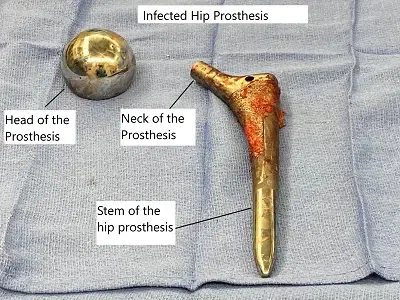
Componentes protésicos retirados debido a fallos
When should you consider surgery:
The usual signals are returning hip pain, new instability / repeated dislocations, reduced mobility, or signs of infection. This includes pain and a draining wound.
If your surgeon suspects a problem, they’ll usually run more tests than they did the first time around. Often we order blood tests and imaging (X-ray, CT, MRI, or bone scan), and frequently we draw a sample of fluid from the joint to check for infection, since infection is treated very differently.
Confirming the exact cause is important, because it shapes what kind of revision surgery you’ll need.
What happens during revision surgery:
The exact procedure depends on what failed, and it’s more involved than the original surgery. Working through the old incision or a new one, the surgeon examines the tissues and parts to see what’s loose or infected. From there:
- If only part of the implant is worn (and the rest is still firmly attached), sometimes just the plastic liner and the ball are swapped out.
- If parts are loose, they’re carefully removed. We try to preserve as much of your bone as possible. Occasionally the surgeon makes a controlled opening in the bone to get a stuck part out.
- Special revision implants are then used to rebuild the joint. These often include longer, stouter, bone in growing stems for better stability. We may also use adjustable «modular» stems that can compensate for missing bone. If a lot of bone is gone, donor bone graft or metal pieces may be used to build it back up.
Infection makes things more complex. When the implant is infected, the surgery is often done in two stages: first the infected implant is removed, the joint is thoroughly cleaned, and a temporary antibiotic-loaded spacer is put in.
After several weeks of antibiotics clear the infection, a second surgery puts in the new permanent implant. (In select cases this can be done in a single stage.) Treating an infected implant usually also means a long course of IV antibiotics and a longer recovery.
What does recovery look like:
Recovery from a revision is longer than from the original hip replacement. The exact length depends on why the revision was needed. For the first 4-6 weeks, everyday tasks like cooking, shopping, bathing, laundry, and driving are limited.
Most people get around with crutches or a walker and follow precautions that restrict certain movements. Full recovery and return to favorite activities takes about 4-6 months. Driving can usually be resumed at 6 weeks. Most of the time we want you walking the first day after surgery. Sedetary work can usually be resummed around 4-6 weeks post op but heavy manyal labor may take 4+ months.
The reassuring part: even though it’s a longer road, most people end up with the same pain-free, mobile hip. Revision surgery is designed to restore this.
What are the major risks and complications:
Because revision surgery takes longer and the recovery is more drawn out, the risks are somewhat higher than with the original hip replacement surgery. They include:
- Infection.
- Blood clots in the leg, which can be dangerous if one travels to the lungs.
- Nerve or blood vessel injury near the surgical area.
- A difference in leg length afterward.
- The bone failing to bond to the new implant, or the implant loosening again.
To lower these risks, surgeons use measures like compression stockings, blood thinners, antibiotics, physical therapy, and activity precautions. Your surgeon will discuss all of this with you.
What if you don’t have surgery:
A failing hip implant generally doesn’t fix itself, so the question is usually when to revise rather than whether to. Left alone, a loose or worn implant tends to keep causing pain and instability. Additionally, the bone loss around it often continues, which can make the eventual repair harder and more complex.
Infection in particular shouldn’t be left untreated, since it can spread and become dangerous. That said, the timing is a decision to make with your surgeon, weighing your symptoms, the imaging, and your overall health.
The encouraging news is that revision surgeries are done very successfully today, with excellent long-term results even though the road is longer.
Revision surgery components:
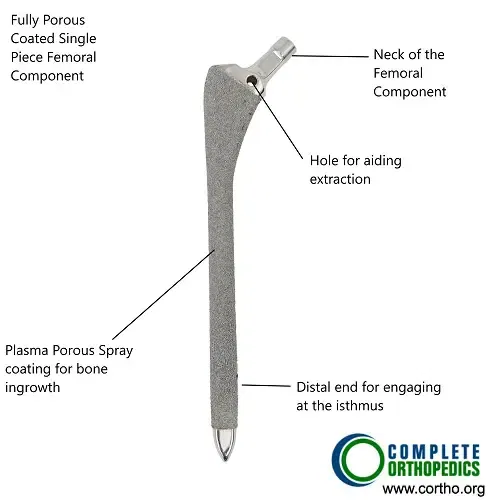
Tallo femoral largo totalmente poroso recubierto con arco anatómico
Durante la cirugía de revisión, normalmente se utiliza un vástago femoral totalmente poroso para mejorar la estabilidad del componente. El vástago también es más largo que la prótesis primaria para proporcionar más estabilidad. Se pueden usar otros tipos de tallos que pueden tener partes superiores e inferiores desmontables (tallos modulares).
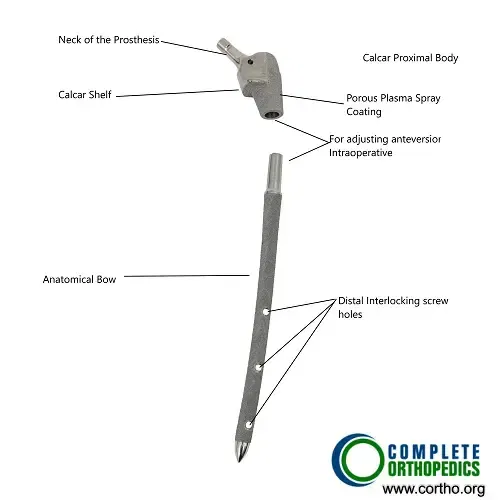
Tallo femoral modular
Un vástago protésico modular permite al cirujano compensar la pérdida ósea excesiva durante la extracción del componente principal. El vástago modular puede consistir en orificios para fijación por tornillo y un recubrimiento totalmente poroso para el crecimiento óseo. La parte superior de la prótesis está diseñada para transferir la carga al interior más fuerte del hueso.
En caso de prótesis infectadas, la cirugía de revisión se vuelve más complicada. La decisión sobre la cirugía se toma tras evaluar la duración y gravedad de la infección. Normalmente se realiza una cirugía en dos fases, en la que en la primera fase se retira el implante infectado.
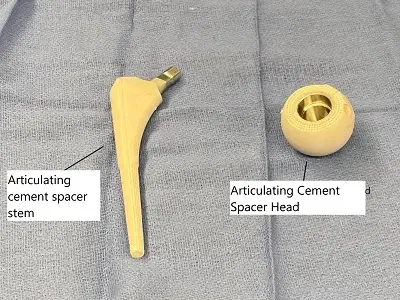
Separador de cemento articulado
La articulación de la cadera se lava a fondo y se introduce un separador de cemento impregnado con antibióticos. Tras la eliminación de la infección en unas semanas, se realiza una segunda cirugía que elimina el separador y se introducen nuevos implantes.
Insurance & Cost
Revision Hip Replacement at Complete Orthopedics is covered by Medicare and most major insurance carriers (Aetna, Anthem BCBS, Cigna, Empire BCBS, UnitedHealthcare), as well as most workers’ compensation and no-fault insurance plans. Your out-of-pocket cost depends on your specific plan, deductible, and the medical necessity criteria that apply to your case.
Call our billing team at (631) 981-2663 before scheduling to verify your coverage and discuss expected out-of-pocket costs. For the full list of carriers we accept and patient billing protections, see our Insurance Information page.
¿Tienes más preguntas?
¿Qué es la cirugía de reemplazo de cadera?
La cirugía de reemplazo de cadera de revisión es un procedimiento que se realiza para reemplazar una articulación artificial de cadera previamente implantada que se ha desgastado, se ha dañado o ha fallado por diversas razones.
¿Cuándo podría alguien necesitar una cirugía de reemplazo de cadera?
Puede ser necesaria una cirugía de revisión de reemplazo de cadera debido a factores como el aflojamiento del implante, infección, fractura alrededor del implante, inestabilidad o desgaste de la articulación artificial con el tiempo.
¿Cuáles son las señales de que una prótesis de cadera puede necesitar revisión?
Las señales que indican la posible necesidad de un reemplazo de cadera de revisión incluyen dolor persistente, inestabilidad o luxación de la cadera, dificultad para caminar o apoyar peso, y evidencia de fallo del implante en estudios de imagen.
¿En qué se diferencia la cirugía de reemplazo de cadera de revisión de la prótesis primaria?
La cirugía de revisión de reemplazo de cadera es más compleja que la de reemplazo primaria, ya que implica retirar el implante existente, abordar cualquier pérdida ósea o problemas estructurales y luego sustituirlo por un nuevo implante.
¿Cuáles son los riesgos asociados a la cirugía de reemplazo de cadera por revisión?
Los riesgos de la cirugía de reemplazo de cadera de revisión incluyen infecciones, coágulos sanguíneos, lesiones nerviosas, fracturas, luxaciones y la necesidad de realizar más cirugías de revisión en el futuro.
¿Cuánto tiempo se tarda en recuperarse de una cirugía de reemplazo de cadera?
El tiempo de recuperación tras una cirugía de revisión de reemplazo de cadera varía en función de factores como la salud general del paciente, la extensión de la cirugía y cualquier complicación que se haya encontrado durante el procedimiento. Generalmente, puede tardar varios meses en recuperarse completamente.
¿Cuál es la tasa de éxito de la cirugía de reemplazo de cadera por revisión?
La tasa de éxito de la cirugía de reemplazo de cadera por revisión depende de varios factores, como el motivo de la revisión, la habilidad del cirujano y la salud general del paciente. En general, las tasas de éxito son altas, con muchos pacientes experimentando una mejora significativa en los síntomas y la función.
¿Se pueden revisar todos los implantes de cadera?
Aunque la mayoría de los implantes de reemplazo de cadera pueden revisarse, algunos factores como el diseño del implante, el método de fijación y la calidad ósea pueden afectar la viabilidad y el éxito de la cirugía de revisión.
¿Cómo sé si soy candidato para una cirugía de reemplazo de cadera?
Los candidatos a la cirugía de reemplazo de cadera de revisión suelen someterse a una evaluación exhaustiva por parte de un cirujano ortopédico, que incluye examen físico, estudios de imagen y revisión del historial médico, para determinar el curso de tratamiento más adecuado.
¿Existen alternativas a la cirugía de reemplazo de cadera?
Dependiendo de las circunstancias específicas, las alternativas a la cirugía de reemplazo de cadera pueden incluir un manejo conservador con medicación, fisioterapia u otras intervenciones no quirúrgicas. Sin embargo, en muchos casos, la cirugía de revisión puede ser la opción más eficaz para abordar el fallo o complicaciones del implante.
¿La cirugía de repaso de cadera aliviará todo mi dolor de cadera?
Aunque la cirugía de reemplazo de cadera de revisión tiene como objetivo aliviar el dolor de cadera y mejorar la función, puede que no elimine completamente todos los síntomas, especialmente si existen problemas subyacentes como daño nervioso o pérdida ósea extensa.
¿Qué tipo de anestesia se utiliza para la cirugía de reemplazo de cadera?
La cirugía de reemplazo de cadera de revisión suele realizarse bajo anestesia general, aunque en algunos casos también pueden emplearse técnicas de anestesia regional como la espinal o epidural.
¿Cuánto tiempo tarda la cirugía de revisión de la cadera?
La duración de la cirugía de reemplazo de cadera de revisión varía según factores como la complejidad del caso y cualquier complicación imprevista, pero generalmente tarda varias horas en completarse.
¿Necesitaré fisioterapia tras una cirugía de revisión de la cadera?
Sí, la fisioterapia es un componente esencial de la rehabilitación tras la cirugía de revisión de la cadera. Un programa de ejercicio estructurado ayuda a mejorar la fuerza, el rango de movimiento y la movilidad funcional.
¿Qué puedo esperar durante el periodo de recuperación tras una cirugía de reemplazo de cadera?
Durante el periodo de recuperación, los pacientes pueden esperar recuperar gradualmente la movilidad y la función con la ayuda de la fisioterapia. El dolor y las molestias son comunes al principio, pero deberían mejorar con el tiempo
¿Hay restricciones en las actividades tras la cirugía de reemplazo de cadera?
Aunque las restricciones de actividad pueden variar según las circunstancias individuales y las recomendaciones del cirujano, generalmente se recomienda a los pacientes evitar actividades de alto impacto y levantar pesos pesados para evitar fallos o complicaciones del implante.
¿Necesitaré tomar medicación después de una cirugía de revisión de cadera?
Dependiendo de las necesidades individuales del paciente, pueden prescribirse medicamentos como analgésicos, antibióticos y anticoagulantes tras una cirugía de revisión de la cadera para controlar el dolor, prevenir infecciones y reducir el riesgo de coágulos sanguíneos.
¿Con qué frecuencia tendré que hacer seguimiento con mi cirujano después de una cirugía de reemplazo de cadera?
Las citas de seguimiento con el cirujano suelen programarse a intervalos regulares tras la cirugía de revisión de la cadera para monitorizar la cicatrización, evaluar el progreso y abordar cualquier preocupación o complicación que pueda surgir.
¿Se puede realizar la cirugía de reemplazo de cadera mediante técnicas mínimamente invasivas?
En algunos casos de cirugía de reemplazo de cadera de revisión pueden utilizarse técnicas mínimamente invasivas, dependiendo de factores como la anatomía del paciente y la complejidad de la revisión. Sin embargo, no todos los casos son adecuados para enfoques mínimamente invasivos.
¿Qué factores afectan al éxito de la cirugía de reemplazo de cadera?
Los factores que influyen en el éxito de la cirugía de reemplazo de cadera de revisión incluyen la experiencia y habilidad del cirujano, el motivo de la revisión, el estado del hueso y los tejidos circundantes, y la salud general del paciente y el cumplimiento de las instrucciones postoperatorias.
¿Necesitaré transfusiones de sangre durante o después de la cirugía de revisión de cadera?
Las transfusiones de sangre pueden ser necesarias durante o después de la cirugía de revisión de la cadera, especialmente en casos de pérdida significativa de sangre. Tu cirujano hablará sobre la posible necesidad de transfusiones y atenderá cualquier duda que tengas.
¿Cómo puedo minimizar el riesgo de complicaciones durante y después de la cirugía de reemplazo de cadera de revisión?
Seguir las instrucciones preoperatorias de tu cirujano, mantener una buena salud general y seguir las pautas postoperatorias como restricciones de actividad, regímenes de medicación y fisioterapia puede ayudar a minimizar el riesgo de complicaciones y promover un resultado exitoso.
¿Qué debo hacer si experimento síntomas inesperados o complicaciones tras una cirugía de reemplazo de cadera?
Si experimenta síntomas inesperados o complicaciones tras una cirugía de reemplazo de cadera, como aumento del dolor, hinchazón, fiebre o dificultad para la movilidad, es importante contactar con su cirujano cuanto antes para su evaluación y manejo. La detección e intervención tempranas pueden ayudar a prevenir complicaciones adicionales y promover una recuperación óptima.
El contenido de esta página ha sido redactado, editado o aprobado por los médicos que se indican a continuación y fue revisado por última vez para verificar su exactitud el 11 de noviembre de 2026.