

Your hands are essential to nearly everything you do from the simplest daily tasks to your most demanding activities.
When pain, numbness, or weakness begins to interfere, it can affect your quality of life in profound ways.
Carpal Tunnel Syndrome is one of the most common nerve conditions affecting the hand and wrist, and without proper treatment, symptoms can worsen over time.
At Complete Orthopedics, our hand surgery specialists in New York are dedicated to providing expert, personalized care for Carpal Tunnel Syndrome.
Whether your condition can be managed with conservative treatments or requires surgical intervention, we offer a comprehensive range of options.
It including minimally invasive carpal tunnel release surgery, all tailored to relieve your symptoms, restore function, and help you return to the activities you love.
How Common It Is and Who Gets It
Carpal Tunnel Syndrome affects millions of people, especially those who perform repetitive movements or work in certain environments. (e.g IT professionals, construction workers)
It is more common in women, particularly during pregnancy or menopause. Age is also a factor, with CTS typically affecting individuals aged 40 to 60 years.
Those with certain medical conditions, such as diabetes, obesity, or hypothyroidism, are also at a higher risk.
Causes
CTS occurs when the space inside the carpal tunnel, which houses the median nerve, is reduced.
This compression can be caused by a variety of factors, including swelling of the tissue lining the tunnel (flexor tenosynovitis), fluid retention, ganglion cysts, or abnormal muscle structures.
In many cases, the exact cause is unknown. Overuse, repetitive hand movements, and certain health conditions can contribute to the development of CTS.
Anatomy
The carpal tunnel is a narrow passageway in the wrist that is formed by the eight carpal bones and the transverse carpal ligament.
The median nerve and nine tendons pass through this tunnel to reach the hand.
The median nerve is responsible for sensation in the thumb, index finger, middle finger, and part of the ring finger. It also controls some of the muscles in the hand that enable fine motor skills.
Symptoms
Patients with CTS often experience tingling, numbness, or a “pins and needles” sensation, especially in the thumb, index, and middle fingers.
These symptoms may worsen at night and may be relieved by shaking or rubbing the hand.
As the condition progresses, weakness in the thumb can occur, making it difficult to perform tasks such as opening jars or gripping objects.
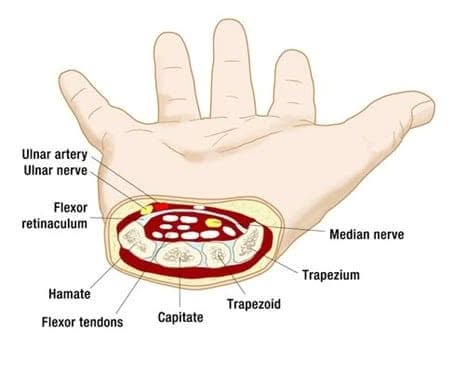
Structure of the Carpal Tunnel
Diagnosis and Imaging
Diagnosis begins with a patient history review and physical examination. Provocative tests like the Tinel sign and Phalen test are commonly used to diagnose CTS.
Electrodiagnostic tests such as nerve conduction velocity (NCV) and electromyography (EMG) may be performed to confirm the diagnosis and assess the severity.
Treatment Options
Non-Surgical Care
Non-surgical treatments are often the first line of treatment for CTS. These include wrist splints, especially worn at night, to keep the wrist in a neutral position.
Activity modification, such as avoiding repetitive wrist movements, can also help alleviate symptoms.
In some cases, steroid injections may provide relief by reducing inflammation in the carpal tunnel.
Surgical Care
If conservative treatments fail, surgery may be necessary.
The goal of surgery is to relieve pressure on the median nerve by releasing the transverse carpal ligament or performing a flexor synovectomy. Carpal tunnel release surgery.
Surgery can be performed using open, mini-open, or endoscopic techniques, though the mini-open approach is often preferred to avoid complications associated with endoscopic procedures.
Recovery and What to Expect After Treatment
After surgery, patients typically wear a wrist splint for about two weeks to allow for healing and protect the wrist from accidental injury.
Stitches are removed after two weeks, and patients may need to continue using a wrist brace for several weeks, especially during work or at night.
Recovery time varies, but the median nerve usually takes between 8 weeks to 6 months to fully recover. Many patients can return to light work after a month, with full activity resumed in 6 to 8 weeks.

Complications
Complications of CTS surgery include infection, nerve injury, stiffness, and scarring.
In rare cases, the median nerve may be inadvertently cut during endoscopic surgery. If left untreated, CTS can lead to permanent nerve damage and muscle atrophy in the hand.
Prognosis
With proper treatment, the outlook for CTS is generally good.
Symptoms often improve after surgery, with most patients experiencing significant relief from pain, numbness, and weakness.
However, recovery from nerve damage may take time, and some patients may continue to experience mild symptoms even after surgery.
Specialists and Team Involved
Carpal Tunnel Syndrome is typically diagnosed and treated by orthopedic surgeons, hand surgeons, or neurosurgeons. In some cases, physical therapists may be involved in the rehabilitation process after surgery.
When to See a Specialist
You should consult a specialist if you experience persistent numbness, tingling, or pain in your hand, especially if these symptoms interfere with your daily activities.
What Happens If You Ignore It
Ignoring carpal tunnel syndrome can lead to permanent nerve damage, weakness, and muscle atrophy in the hand. In severe cases, untreated CTS can result in long-term disability.
How to Prevent It
Preventive measures include avoiding repetitive wrist movements, maintaining good ergonomics, and taking breaks during tasks that involve extended hand use.
Regular hand exercises can also help strengthen the muscles and tendons around the carpal tunnel.
Activity and Lifestyle Modifications
For those at risk of CTS, modifying daily activities to reduce stress on the wrist, such as using ergonomic tools and taking regular breaks, is important. Engaging in hand and wrist strengthening exercises may also help prevent the development or progression of CTS.
The content on this page has been authored, edited, or approved by the doctors below, and was last reviewed for accuracy on June 25, 2026.